Motivation-based Action Selection and Emergence of Locomotion Behavior for BURs
Utsunomiya University · Aichi Institute of Technology
Overview
Conventional multifunctional BURs rely on explicitly programmed, task-level behaviors, limiting how flexibly actions are selected and how much behavioral diversity can emerge. This paper proposes a control system that integrates motivational states directly to motion primitives, with the dominant primitive selected for each joint via an element-wise maximum. Hybrid, multi-mode behaviors thereby emerge from the interaction of motivations, rather than from predefined rules. Physical experiments (slope traversal, a sedimentation basin, swimming, walking, crab-like gait, and bouncing gait) confirmed the approach, with a potential-method analysis showing a 15.6% improvement in energy cost per behavior over a conventional method.
Key Contributions
A control design using motion primitives based on motivational states enables action selection and emergence of different behaviors in a multifunctional BUR. Motivational states determine motion primitives, generating hybrid behaviors such as swimming and walking rather than predefined behavior patterns.
As a quantitative evaluation of action selection and emergence, we formulate dynamical equations in motion primitive space using the potential method, confirming the emergence of swimming, walking, crab-like gait, and bouncing gait, along with their coordinated combinations.
How It Works
1. Deficit & motivation estimation. The robot continuously computes a "deficit" for each of five monitored variables — roll, pitch, yaw, depth/buoyancy, and internal energy consumption — based on how far each deviates from an ideal value. A biologically inspired hormonal-modulation term (modeled after energy-saving behavior in fish at cleaning stations) shapes how these deficits build up or decay over time, producing a motivational state for each variable.
2. Motion primitives. Three fundamental motion primitives — swing/twist, up/down, and synchronous/asynchronous joint coordination — are generated directly from the motivational states via saturation functions. These correspond to biologically grounded movement patterns such as flapping/feathering fins or in-phase/out-of-phase limb coordination.
3. Element-wise selection. Rather than picking one behavior for the whole robot, the system selects the dominant primitive independently for each joint using an element-wise maximum across competing motivational states. This distributed competition is what allows hybrid, previously unseen behaviors to emerge — e.g., one side of the robot swimming while the other walks.
4. Motor control. The selected primitives feed into a central pattern generator (CPG) that produces the final rhythmic joint commands (phase, amplitude, and offset) driving the robot's 16 joints (4 fins × 4 axes each).
Experiments & Results
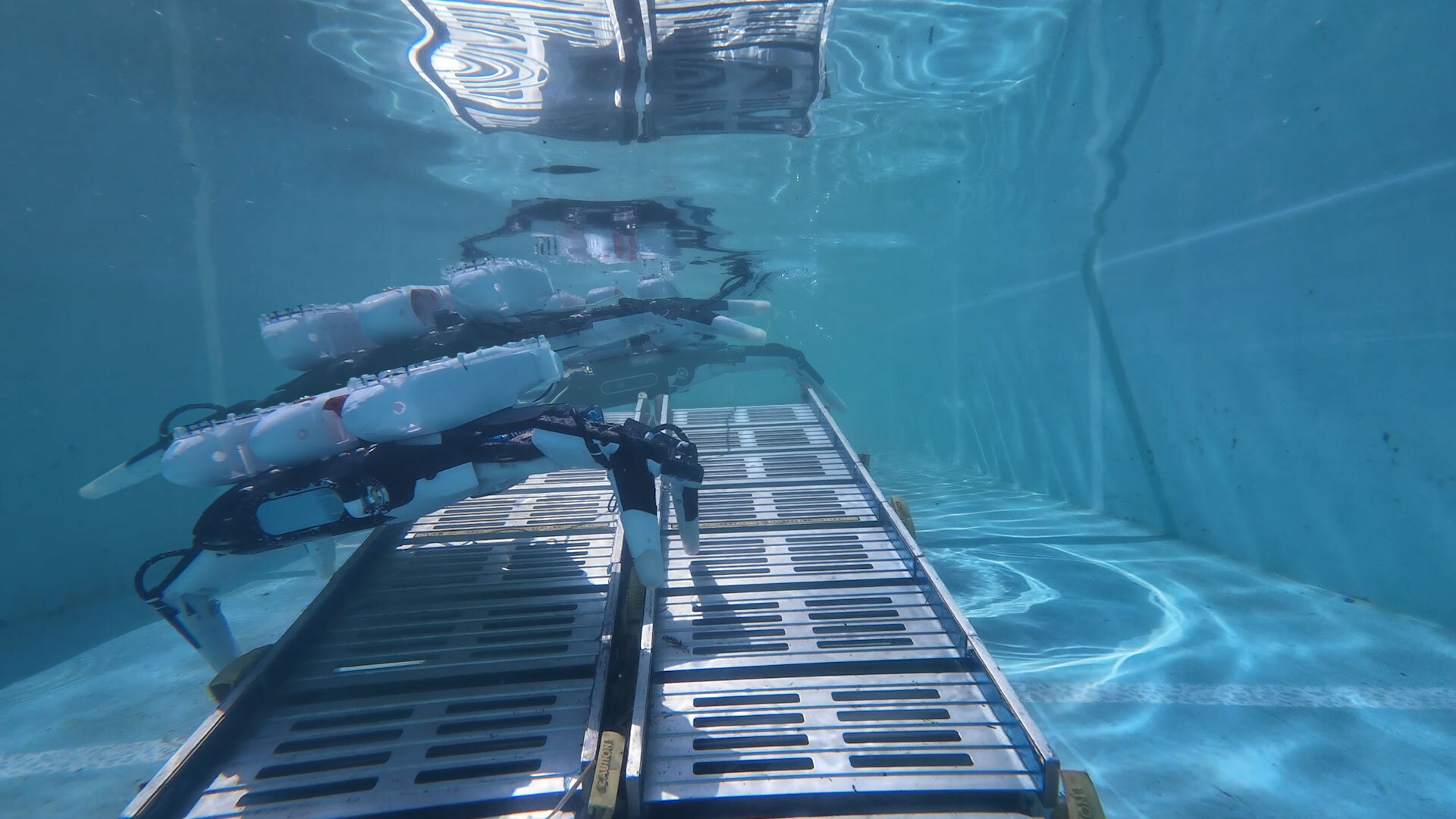
The system was experimented in an outdoor pool with a slope obstacle, a soft-sediment basin, and a Webots simulation environment.
- Slope ascent/descent: The robot spontaneously transitioned between walking and swimming gaits, and in some trials exhibited a crab-like sideways gait.
- Sediment basin: Despite the soft, unstable seabed, the robot achieved locomotion by emergently producing a bouncing gait.
- Parameter sensitivity: Weaker motivational "strength" (parameter α) made the system more likely to produce novel, unplanned behavior combinations, while stronger values produced faster but less diverse responses.
- System dynamics analysis: A potential-function model of the motion-primitive space showed that swim behavior corresponds to positive system dynamics and walk behavior to negative dynamics, with brief sign-crossing spikes marking the emergence of hybrid crab-like and bouncing gaits.
Conclusion
We proposed a control method that integrates motion primitives into a motivation-based action selection mechanism to enable emergent locomotion behaviors, determining the motion primitive for each element via an element-wise maximum based on the robot's motivational state. Combinations of motion primitives enable diverse emergent behaviors and hybrid locomotion, allowing a multifunctional, multi-joint BUR to select and emerge with behaviors such as swimming and gait motion rather than relying on predefined patterns. Future work will extend this system to more complex scenarios and other multifunctional BUR platforms.
BibTeX
@article{Asada2026Motivation,
  title   = {Motivation-based Action Selection and Emergence of Locomotion Behavior for BURs},
  author  = {Asada, Takumi and Furuhashi, Hideo and Tabata, Kenta and Miyagusuku, Renato and Ozaki, Koichi},
  journal = {IEEE Robotics and Automation Letters},
  year    = {2026},
  note    = {Preprint, accepted September 2026},
  url     = {https://ieeexplore.ieee.org/document/11692900}
}