Performance Evaluation Using Sim2Real of a Robotic Dolphin With Multi-Link Body Mechanism and CPG-Based Controller
Abstract
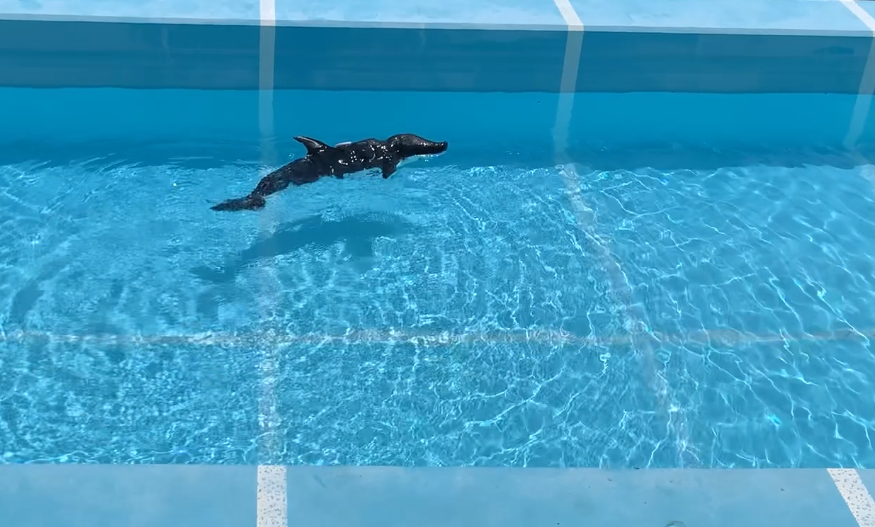
Robotic dolphins combine propulsion from the fluke with maneuverability from the flippers, but achieving both at once is mechanically and computationally difficult: adding drive joints for flexibility only complicates the control system and makes performance harder to evaluate. This work proposes a robotic dolphin with a multi-link body mechanism — three yaw axes from the head to the body, four pitch axes from the body to the fluke, and one axis on each flipper — capable of both propulsion and maneuverability within a single whole-body structure.
The mechanism is driven by a CPG (central pattern generator) locomotion controller with a two-layer network structure, integrating fluke and flipper control into a single algorithm. Because the number of CPG parameters grows with the number of joints, the robot dynamics and control algorithm were both developed and verified through Sim2Real, using a ROS2/Webots simulation alongside a physical prototype tested in a shallow experimental pool.
Sim2Real trials showed close agreement between simulated and real trajectories, surge speed, and yaw turning behavior, with a turning-radius error of just 3.83% between simulation and the real robot. The proposed dolphin reached a swimming number of 0.241 — the highest reported among robotic dolphins capable of both surge swimming and turning — while operating at comparatively low actuation frequencies, indicating that the multi-link body and integrated CPG control achieve efficient propulsion and maneuverability together.
Method: Multi-Link Body and Two-Layer CPG Controller
Configuration and topology of the CPG network
- Structure: seven joints run from head to fluke (yaw, pitch, yaw, yaw, pitch, pitch, pitch), with one yaw-axis joint on each flipper — 0.758 m long, 0.132 m wide, 0.136 m high, shaped after a NACA 0018 airfoil, and waterproofed with chloroprene rubber and O-rings.
- Hardware/software: a Raspberry Pi 4 runs the ROS2-based control stack, receiving input from a wireless controller and driving KRS-4034HV servo motors; Rviz2 visualizes joint state, and Webots provides the matched simulation environment.
- Body locomotion: seven oscillators connected in a single-chain structure (SCS) from the center of gravity to the head and fluke generate swimming amplitude and phase.
- Flipper locomotion: four oscillators in a nearest-neighbor structure (NNS) couple to the body chain, driving flipper motion for turning and fine adjustments alongside fluke-based surge and yaw control.
Sim2Real Evaluation
Surge Motion and Yaw Turning
Joint trajectories, surge speed, and yaw-turning behavior measured on the real robot closely tracked the Webots simulation once the damping coefficient was tuned to ζ = 0.5 using repeated Sim2Real2Sim cycles. Surge speed increased linearly with CPG frequency in both environments, reaching 0.107, 0.125, and 0.146 m/s at 0.6, 0.7, and 0.8 Hz on the real robot, and the yaw-turning radius and rate errors between simulation and reality stayed under 6%, supporting the use of simulation to evaluate multi-link BUR (biomimetic underwater robot) algorithms in advance of real-world testing.
Comparative Swimming Performance
Using the swimming number Sw = U/fL to compare robots of different lengths and operating frequencies, the proposed robotic dolphin reached Sw = 0.241 — the highest value reported among robotic dolphins capable of both surge swimming and turning. This performance was achieved at a comparatively low actuation frequency (0.6–0.8 Hz), attributed to thrust generation from the multi-link body combined with efficient two-layer CPG control and the flexibility of the rubber waterproofing at each joint.
Limitations and Future Work
- Small z-axis displacement errors between simulation and reality are attributed partly to elastic deformation of the chloroprene rubber waterproofing at each joint.
- Added-mass and added-inertia terms were approximated using Lamb's k-factor for an ellipsoid; more accurate parameter identification (e.g., zig-zag and variable-drag tests) is expected to further reduce the Sim2Real gap.
- The current Sim2Real workflow assumes shallow, calm water; operating in ocean waves or deeper water will require additional manual parameter adjustment, including disturbances from waves and changes in water pressure.
- Future work includes introducing real-time parameter adjustment to further improve performance of underwater robots with multi-link mechanisms.
BibTeX
@article{Asada2025RoboticDolphinSim2Real,
  title   = {Performance Evaluation Using Sim2Real of a Robotic Dolphin With Multi-Link Body Mechanism and CPG-Based Controller},
  author  = {Asada, Takumi and Oki, Takao and Furuhashi, Hideo and Tabata, Kenta and Miyagusuku, Renato and Ozaki, Koichi},
  journal = {IEEE Access},
  volume  = {13},
  pages   = {190304--190316},
  year    = {2025},
  doi     = {10.1109/ACCESS.2025.3624365},
  url     = {https://ieeexplore.ieee.org/abstract/document/11214327}
}